HOME » Where lie the opportunities for low-altitude economy in the 15th Five-Year Plan? The Yangtze River Delta is quickly revealing the answers.
Where lie the opportunities for low-altitude economy in the 15th Five-Year Plan? The Yangtze River Delta is quickly revealing the answers.
This year, the Outline of the 15th Five-Year Plan has formally incorporated the low-altitude economy into China’s development system for strategic emerging industries. It explicitly calls for “fostering an industrial ecosystem for the low-altitude economy, improving the service support system for low-altitude flight, and advancing the sound and secure development of general aviation and the low-altitude economy.”
Having been included in the Government Work Report for three consecutive years, the low-altitude economy is highlighted in the Outline of the 15th Five-Year Plan, which sets out to build its industrial ecosystem and upgrade low-altitude flight support services. Meanwhile, the newly revised Civil Aviation Law has taken effect, delivering stronger legal safeguards for new types of aircraft such as unmanned aerial vehicles (UAVs) and eVTOLs. As a core national strategy, the low-altitude economy has entered a new phase featuring more mature policies, clearer industrial layout and wider application scenarios.
For enterprises along the industrial chain, the low-altitude economy is unlocking new market potential. Every segment of the industrial chain is embracing fresh growth opportunities, ranging from complete aircraft manufacturing and core components to communication, navigation, energy systems, operational services and scenario-based applications.
01 Opportunities in the Yangtze River Delta: Industrial Agglomeration Unlocks New Space for Low-Altitude Economy
The industrial positioning of the low-altitude economy has achieved a “three-leap progression”: evolving from a “new growth engine” to an “emerging industry”, and further to an “emerging pillar industry”. Central SOEs have opened up seven major application scenarios: power inspection, oil and gas patrol, emergency rescue, agricultural and forestry operations, low-altitude logistics, urban governance, and low-altitude cultural tourism.
As of April 2026, the total number of market entities related to the low-altitude economy nationwide has exceeded 100,000. A spatial layout is gradually taking shape, with the Pearl River Delta as the core, the Beijing-Tianjin-Hebei region as the leader, the Chengdu-Chongqing region as the growth pole, and the Yangtze River Delta as a key pillar.
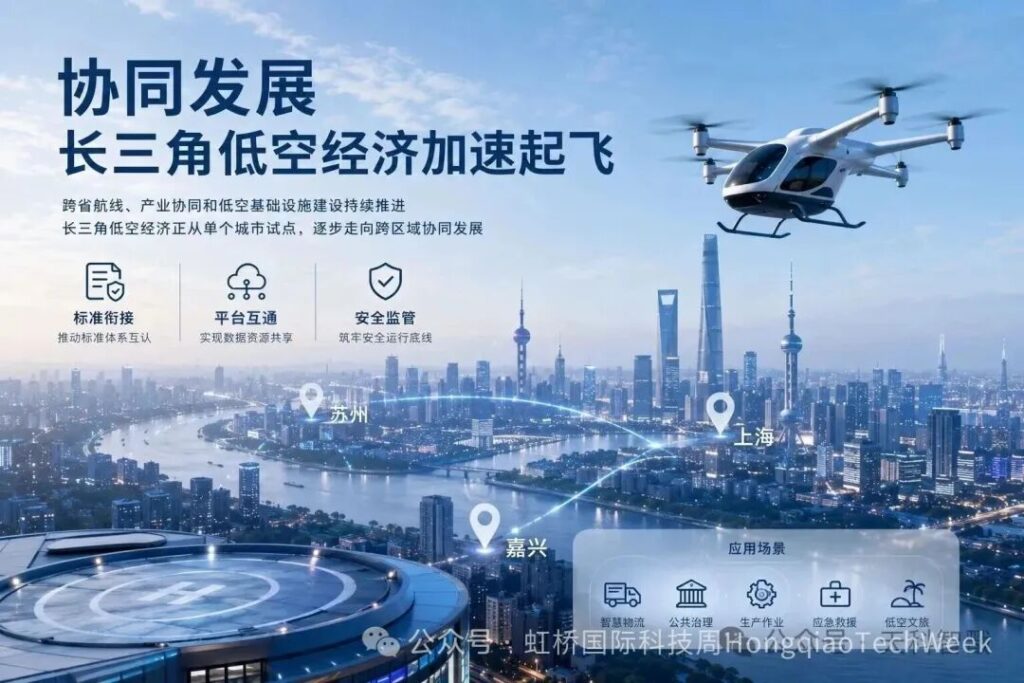
*In March 2025, the interprovincial low-altitude passenger air route linking Shanghai, Jiaxing and Suzhou launched networked operations. (Source: Tianke Zhijian)
The Yangtze River Delta is stepping up efforts to foster eVTOL clusters and pursue high-end manufacturing innovation, building an industrial ecosystem for coordinated development. Shanghai hosts 50% of China’s leading innovative enterprises in the low-altitude economy. It is the only city nationwide that deploys all three mainstream technical routes — ton-class compound wing, tiltrotor and ducted fan aircraft, delivering robust support for industrial technological innovation.
Leveraging its strengths in advanced manufacturing, Jiangsu is accelerating the development of equipment manufacturing and low-altitude infrastructure. Suzhou targets a low-altitude economy industrial scale of 600 billion yuan by 2026.
Zhejiang keeps expanding application scenarios including low-altitude cultural tourism and logistics distribution, and has cultivated a series of commercial cases with exemplary value.
Anhui is pressing forward with low-altitude airspace reform and continuously improving low-altitude flight support capacity, creating more open space for new technologies and new business forms.
02 Focus on Future Mobility & Energy, Gather Innovative Momentum for the Low-Altitude Economy
As a vital gateway for the integrated development of the Yangtze River Delta and an international hub for opening-up, Shanghai Hongqiao continues to pool technological, industrial, capital and global innovation resources. Drawing on this unique geographical advantage, this Hongqiao Tech Week will focus on future industries represented by the low-altitude economy. Centering on future mobility and energy tracks, the event will build an important platform for enterprises to showcase innovative achievements, expand industrial cooperation and connect with markets across the Yangtze River Delta.
The exhibition will spotlight sectors including eVTOLs, industrial UAVs, low-altitude logistics, intelligent flight control systems, power systems, energy technologies, Beidou navigation, low-altitude communications, intelligent air traffic management, and relevant application solutions. We sincerely invite industrial chain enterprises, research institutes, investment institutions, professional visitors and industry partners to participate. Through exhibitions, exchanges, industrial matchmaking and themed events, we aim to boost technical dialogue and commercial cooperation.
03 More than an exhibition, it serves as a vital channel to connect industrial resources across the Yangtze River Delta.
The Yangtze River Delta is not only one of China’s most dynamic regions for the low-altitude economy, but also a key hub for close access to leading enterprises, research institutes, industrial parks, investment institutions and application scenarios. It is an ideal place to showcase innovations, seek partners, expand market channels and seize important opportunities in the fast-growing low-altitude economy.
During the exhibition, Hongqiao Tech Week will also organize a Yangtze River Delta VIP Industrial Park Tour. Professional visitors, industry guests and potential partners will be invited to visit low-altitude economy industrial parks and innovative enterprises to gain firsthand insights into their development models and latest achievements.
A tour route to the China Beidou Industrial Technology Innovation Base (West Hongqiao) has been arranged. As one of China’s first batch of operational Beidou industrial parks and a vital innovation hub for the Beidou spatial information industry in the Yangtze River Delta, the base brings together innovative enterprises and research expertise covering navigation and positioning, spatiotemporal intelligence, intelligent unmanned systems, digital spatial information and other sectors.
This tour enables participants to gain an in-depth understanding of how Beidou technology empowers future industries such as smart cities, intelligent transportation, the low-altitude economy, robotics and the digital economy, and witness the full industrial chain ranging from core technology R&D to collaborative industrial innovation.
If your enterprise intends to leverage the platform of Hongqiao Tech Week to showcase low-altitude economy innovations to professional visitors, industry partners, prospective clients and investment institutions, or hopes to enable more industry stakeholders to gain an in-depth understanding of your business model and technological strengths via enterprise tour activities, please feel free to contact us to jointly explore opportunities for exhibition, exchange and cooperation.
The low-altitude economy is entering a critical phase of rapid development, and the Yangtze River Delta is emerging as a pivotal region for industrial innovation and application implementation in this sector. Hongqiao Tech Week looks forward to collaborating with more enterprises in the low-altitude economy sector to pool innovative strengths, connect industrial resources and seize new opportunities for the development of future industries.
*Some contents of this article are sourced from Feixingbang, Feixing Dongli and Tianke Zhijian. There exists no commercial cooperation, sponsorship, employment or any other form of interest connection between the author and the aforementioned companies.
All images are retrieved from the Internet solely for the purpose of assisting reading, with no commercial intent whatsoever. The copyright of all pictures belongs to their original authors. Should any infringement occur, please contact us promptly and we will remove the relevant materials immediately.
【About Hongqiao Tech Week】
The inaugural Hongqiao Tech Week is scheduled to kick off at the National Exhibition and Convention Center (Shanghai) from November 20 to 22, 2026. Adopting the theme Global Tech Visions, Localized Chinese Momentum, the event gathers global enterprises, visionary leaders, startups, investment institutions and providers of cutting-edge solutions. By deeply integrating conferences, exhibitions, cultural experiences and high-end networking activities, it seeks to build transformative partnerships and identify core technologies that will reshape industries across Asia and worldwide.
Exhibit & Sponsor · Hongqiao Tech Week 2026
Where are you based?
Choose your region and we'll take you to the right team and packages.